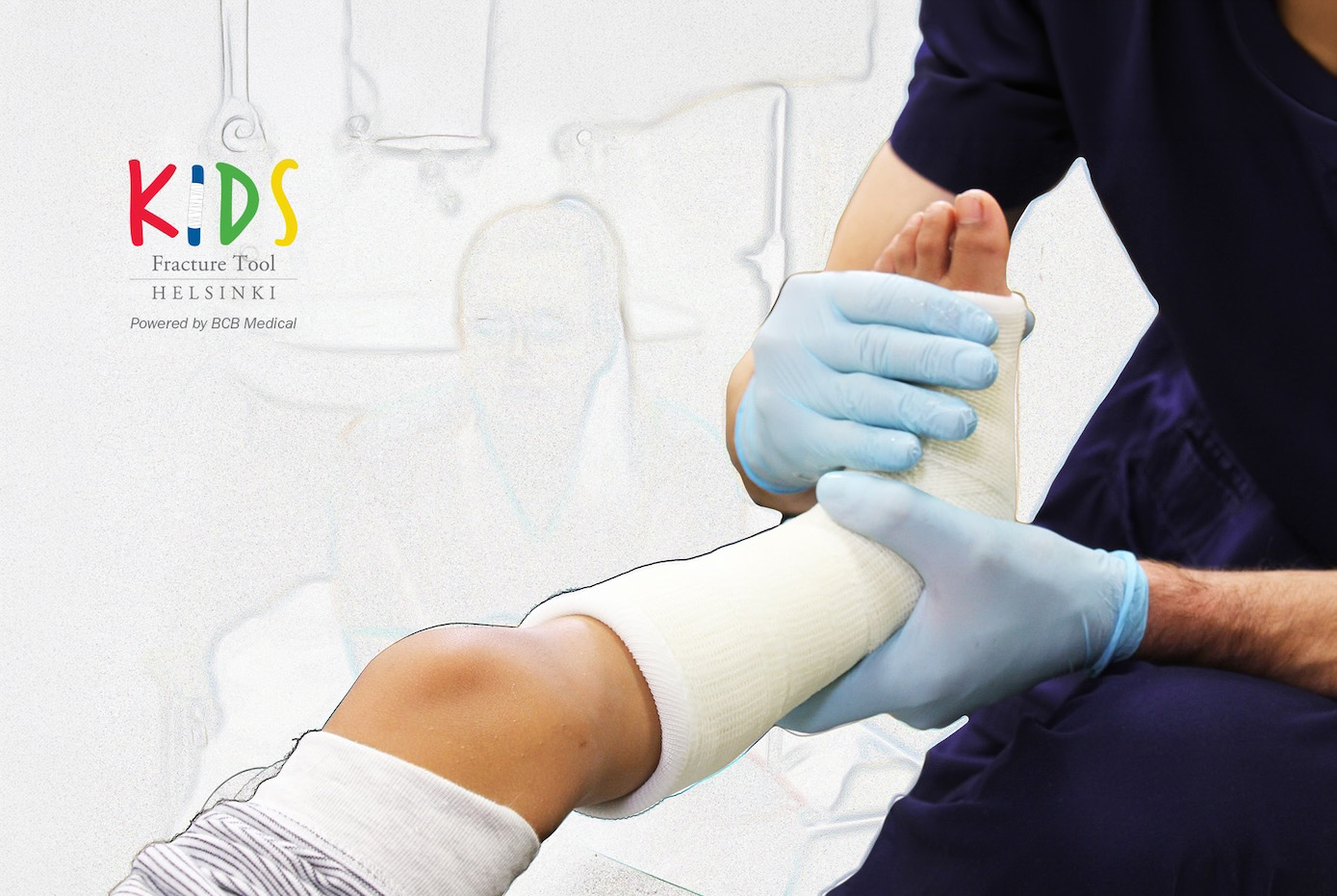
Safe and effective paediatric fracture care at HUS New Children’s Hospital
How safe is children’s fracture care, and how should its quality be measured? A study from HUS New Children’s Hospital in Helsinki answers with data from more than 10,000 fractures, recorded systematically with BCB Medical’s KIDS Fracture Tool. The results show very low complication rates and highly satisfied families, and make the case for open, data-driven benchmarking of paediatric fracture care.
Registry data shows minimal complication rates in children’s fracture surgery
Surgical fracture care at HUS New Children’s Hospital in Helsinki is delivered safely and effectively, with minimal complication rates. A registry-based study published in Acta Orthopaedica in 2026 reviewed all 10,144 fractures diagnosed at the hospital between 2018 and 2022.
Permanent treatment-related nerve injuries were found in just 0.04% of fractures, and deep infections in 0.3%. The study was made possible by systematically collected treatment data, managed with BCB Medical’s KIDS Fracture Tool.
About the KIDS Fracture Tool
The KIDS Fracture Tool is an electronic fracture treatment, quality and registry tool developed by HUS New Children’s Hospital and BCB Medical. Since 2014, every paediatric fracture treated at the hospital has been recorded in it systematically.
The tool captures comprehensive data on each fracture: patient demographics, cause of injury, anatomical location, fracture classification, treatment method, interventions and complications. Since 2021, guardians’ satisfaction with their child’s surgical treatment has also been collected through MyHealth questionnaires sent via the tool, 2, 8 and 26 weeks after surgery.
Because the data is collected prospectively for all patients, a dataset of more than 10,000 fractures was available for research without separate, manual data collection.
Key results
The study assessed the timeliness and safety of care using US News & World Report hospital ranking criteria, complemented with complication data.
| Result | Finding |
| Permanent treatment-related nerve injuries | 0.04% (1 patient) |
| Deep postoperative infections | 0.3% (7 patients) |
| Unplanned return to surgery, Gartland III and femoral shaft fractures | 2.2% |
| Surgery started within 18 hours, Gartland III fractures | 87% |
| Surgery started within 18 hours, femoral shaft fractures | 79% |
| Displaced forearm fractures treated without general anaesthesia | 60% |
| Guardians’ overall satisfaction with surgical treatment | 9.2 / 10 |
Very rare nerve injuries and infections
Permanent nerve injuries caused by treatment and deep postoperative infections are among the most serious complications in children’s fracture surgery. At HUS New Children’s Hospital, both were very rare: only one permanent nerve injury and seven deep infections were recorded. According to the authors, the low rates of reoperations and deep infections compare favourably with published data.
Timely surgery
Most children with severe elbow (Gartland III) or femoral shaft fractures were operated on within 18 hours, a key measure of timely care.
Less anaesthesia for children
Most displaced forearm fractures were treated in the emergency department without general anaesthesia, sparing children and families an operating-room procedure.
Highly satisfied families
Guardians rated their overall satisfaction with their child’s surgical treatment at 9.2 out of 10 on average, measured with MyHealth questionnaires collected through the KIDS Fracture Tool.
Towards data-driven, value-based care
Evidence like this supports the shift towards data-driven, value-based healthcare. It also opens a discussion on how the quality of paediatric fracture care should be assessed and reported in the future. The authors argue that rankings based only on surgical timing give an incomplete picture. Complications, treatment outcomes and patient satisfaction should be measured too.
The study highlights the importance of benchmarking and open collaboration between clinics to improve quality, rather than competition.
In the Nordic countries’ publicly funded healthcare, hospitals do not compete for patients. As the authors put it, better outcomes at one hospital should serve as an example and an incentive for others to improve. To support this, HUS New Children’s Hospital’s fracture treatment results are published openly on the KIDS Fracture Tool website. To the authors’ knowledge, no other institution currently publishes paediatric fracture outcomes on a regular and transparent basis.
By systematically collecting and analysing treatment data with the KIDS Fracture Tool, HUS New Children’s Hospital is ready for national and even international benchmarking. The aim is to bring paediatric fracture treatment towards even better quality and value-based care.
With the KIDS Fracture Tool, clinics can:
- Record treatment and outcome data for every fracture patient
- Follow their own complication rates and results transparently
- Compare results with other clinics through benchmarking on reliable data
- Turn everyday clinical data into published research
Read the full publication
Laaksonen T, Grahn P, Ahonen M, Ahola J-A, Helenius I, Nietosvaara Y. Treatment and outcomes of fractures in children: a registry-based cohort study of 10,144 fractures. Acta Orthopaedica 2026;97:383–387. DOI: 10.2340/17453674.2026.46044